Honoring Royalty, Heritage & Leadership
September 30, 2026

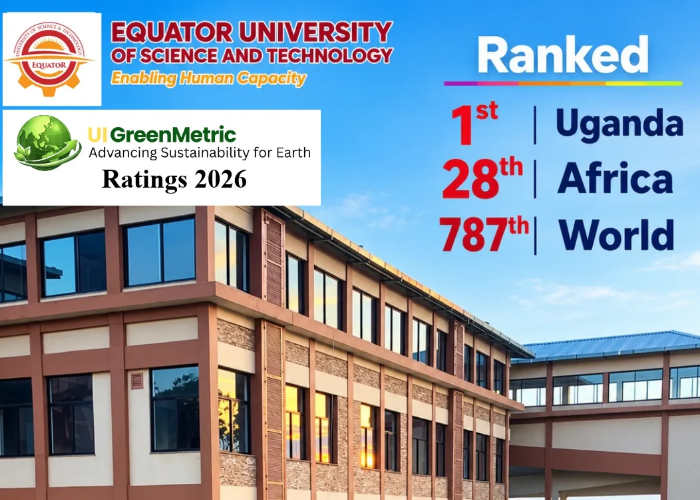
In a world facing increasing environmental pressures, universities have a responsibility that extends beyond classrooms and lecture halls. They are centres of knowledge, research, innovation and community transformation, with the capacity to influence how future generations understand and respond to the challenges facing our planet.
It is within this global context that Equator University of Science and Technology continues to strengthen its commitment to sustainability. Through its participation in the UI GreenMetric Sustainable University Rankings 2026, the University demonstrates its engagement with a broader movement towards environmentally responsible and sustainable higher education.
With a total score of 5,985, the University's performance reflects its engagement across key areas of sustainable campus development, including Setting and Infrastructure, Energy and Climate Change, Waste, Water, Transportation, and Education and Research.
Sustainability is no longer simply an environmental conversation. It encompasses the way institutions build, teach, research, consume resources, manage waste, move people and engage with society.
For Equator University, the UI GreenMetric framework provides an opportunity to examine sustainability through these interconnected dimensions.
The University's 1,175 points in Setting and Infrastructure highlight the importance of creating an environment where campus development and environmental responsibility can exist together. Sustainable infrastructure is about more than physical structures; it involves thoughtful planning, efficient use of space, green areas and creating environments that support learning while recognising the importance of the natural environment.
The University also recorded 1,335 points in Energy and Climate Change, highlighting the importance of energy management and climate-conscious practices within the sustainability agenda. Energy efficiency, conservation and efforts to address climate change are increasingly important considerations for institutions seeking to reduce their environmental impact.
Waste management is another critical component of sustainable development.
With 775 points in the Waste category, sustainability becomes a practical responsibility that involves how resources are consumed, how waste is handled and how institutions can encourage more responsible behaviour.
A sustainable campus requires participation from the entire university community. Students, staff and visitors all play a role in reducing unnecessary waste, promoting responsible consumption and supporting cleaner surroundings.
This connects directly with the principles of SDG 12: Responsible Consumption and Production, which calls for more sustainable patterns of production and consumption.
Water is fundamental to life, education, research and community wellbeing. The University's 625 points in the Water category place water management within its wider sustainability conversation.
Responsible water use requires awareness, conservation and efficient management of this essential resource. It also connects campus sustainability with SDG 6: Clean Water and Sanitation, reinforcing the importance of protecting and managing water resources for present and future generations.
Transportation is another important element of environmental sustainability.
With 1,025 points in Transportation, the University recognises the relationship between mobility, environmental impact and campus life. Sustainable transportation approaches can contribute to reduced emissions, healthier environments and more efficient movement within and around university communities.
This aligns with the ambitions of SDG 11: Sustainable Cities and Communities and SDG 13: Climate Action, where sustainable mobility and climate-conscious development form part of a broader effort to create more resilient communities.
Perhaps the most significant contribution a university can make to sustainability is through the knowledge it creates and the people it prepares.
Equator University's 1,050 points in Education and Research demonstrate the central role of academic activity in the sustainability agenda.
Education equips students with knowledge. Research generates evidence and new solutions. Innovation transforms ideas into practical applications.
Together, these functions can help address challenges ranging from climate change and environmental degradation to sustainable agriculture, public health, renewable energy, responsible resource use and resilient communities.
This is where sustainability becomes more than a campus initiative. It becomes part of the University's contribution to society.
The University's sustainability journey also connects with the United Nations Sustainable Development Goals, a global framework for addressing social, economic and environmental challenges.
Its areas of engagement relate to goals including SDG 4: Quality Education, SDG 6: Clean Water and Sanitation, SDG 7: Affordable and Clean Energy, SDG 9: Industry, Innovation and Infrastructure, SDG 11: Sustainable Cities and Communities, SDG 12: Responsible Consumption and Production, SDG 13: Climate Action, SDG 15: Life on Land, and SDG 17: Partnerships for the Goals.
These connections demonstrate how sustainability can be integrated into the University's broader mission of education, science, technology, research and community engagement.
While rankings provide measurable indicators of performance, the deeper significance of sustainability lies in continuous improvement.
The UI GreenMetric Sustainable University Rankings 2026 provide Equator University with a framework through which different dimensions of sustainability can be assessed and strengthened. The numbers tell part of the story; the actions behind those numbers tell the rest.
For the University community, sustainability represents an ongoing responsibility—to use resources wisely, encourage innovation, protect the environment, strengthen research and equip graduates with the knowledge required to contribute to sustainable development.
The journey does not end with a ranking.
It begins with the recognition that every sustainable decision made on campus can contribute to a much larger global transformation.
Equator University of Science and Technology is positioning sustainability within the broader purpose of higher education: to generate knowledge, develop solutions and prepare people capable of creating meaningful change.
From infrastructure and energy to water, waste, transportation, education and research, sustainability is a shared responsibility.
As the University continues its journey, its message is clear:
Sustainability is not simply about the future we hope to inherit. It is about the future we choose to build today.
Enabling Human Capacity
September 30, 2026
September 25, 2026

September 23, 2026