Ending Violence Against Women and Girls: A Collective Responsibilit...
November 25, 2026

By Equator University of Science and Technology (EQUSaT)
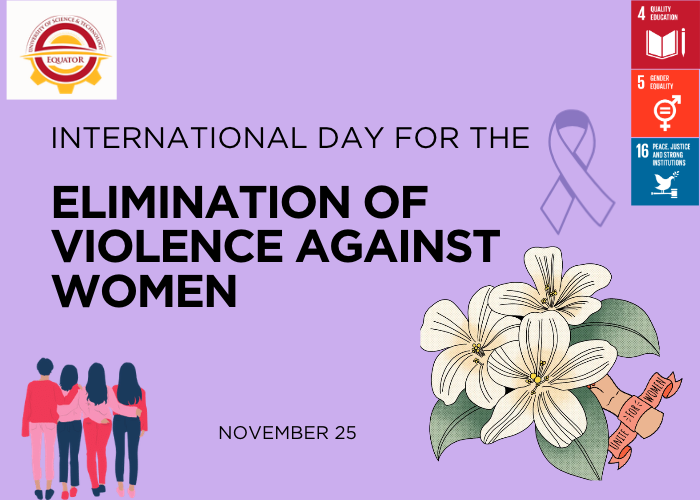
Violence against women is not a private matter to be concealed behind closed doors, nor is it an inevitable part of society. It is a violation of human rights that continues to deny millions of women and girls their dignity, safety, freedom and opportunities.
As the world marks the International Day for the Elimination of Violence against Women, the call is clear: Ensure Justice, Protect Survivors, End Impunity.
The scale of the problem remains deeply concerning. An estimated 840 million women worldwide, nearly one in three, have experienced physical or sexual violence during their lifetime
Violence takes many forms. Beyond physical and sexual assault, women experience psychological abuse, economic control, harassment and increasingly, technology-facilitated violence. Cyber stalking, online threats, sexual exploitation and the non-consensual sharing of intimate images have extended abuse into digital spaces. An estimated 58 per cent of girls and young women have experienced online harassment, demonstrating that the spaces intended to connect and empower people can also become instruments of intimidation.
The consequences are far-reaching. Fear of harassment and violence can limit a woman's freedom of movement, participation in education, professional advancement and ability to contribute meaningfully to society. For young girls, exposure to violence can interrupt education and undermine their prospects long before they have an opportunity to realise their potential.
Education must be part of the solution.
Universities and other learning institutions have a responsibility to promote environments where women and girls can pursue knowledge, develop their abilities and participate in leadership without fear of harassment, intimidation or discrimination. Safe learning environments are not optional; they are fundamental to equal access to education and human development.
This responsibility extends to challenging harmful attitudes, promoting respectful relationships, encouraging accountability and ensuring that survivors are treated with dignity. Men and boys must also be active participants in this effort. Ending violence against women cannot be left to women alone. It requires individuals and communities to challenge behaviours that excuse abuse, normalise harassment or encourage silence.
Equally important is how society responds when violence occurs. Survivors should be heard, believed and supported rather than blamed, shamed or silenced. Access to justice, confidential reporting, appropriate health services and psychosocial support must be strengthened. Perpetrators must be held accountable, and institutions must not turn away from reports of abuse.
At the Equator University of Science and Technology (EQUSaT), the commitment to enabling human capacity is inseparable from the promotion of dignity, equality and respect for human rights. Human potential cannot flourish where fear, discrimination and violence are allowed to thrive.
As an academic community, we recognise the importance of challenging harmful social norms, promoting responsible conduct and contributing to safe and inclusive learning and working environments. Every student and staff member has a role in fostering a culture where harassment is challenged, discrimination rejected and the rights of others respected.
The 16 Days of Activism against Gender-Based Violence, running from 25 November to 10 December, provides an opportunity to move beyond awareness towards meaningful action.
Silence protects abuse. Accountability challenges it. Collective action can prevent it.
Ending violence against women requires more than annual commemorations and public statements. It demands consistent action, responsible institutions and communities willing to confront abuse wherever it occurs.
Every woman and girl deserves to learn, work, lead and live without fear. Her safety is not a privilege; it is a fundamental right.
EQUSaT – Enabling Human Capacity.
November 25, 2026
November 25, 2026
November 19, 2026